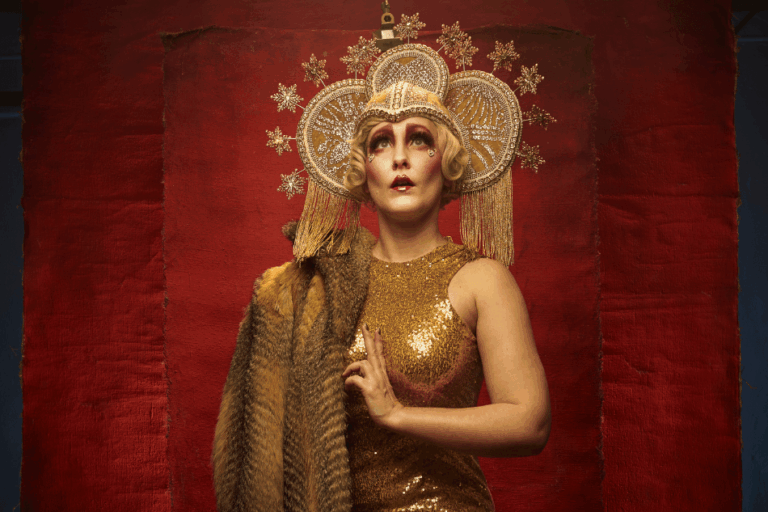
What VENUS Berlin’s Changing Face Says About the Future of Sexuality
From Identity Politics to Creator Capitalism.
Every October, Europe’s largest erotic fair arrives in Berlin. Tens of thousands of visitors walk through its halls. They come for toys, performances, porn stars, workshops, fetish fashion, business meetings and curiosity. The programme changes a little every year. The products evolve. New platforms emerge. Technologies come and go.

But the most revealing part of VENUS has never been what happens inside the exhibition halls.
It is the poster outside.
Advertising has a peculiar honesty. It cannot afford complexity. It has only a few seconds to answer a single question: Who do we want to be?
VENUS Berlin 2026 and the Poster That Says Everything
The 2023 Pornceptual Campaign
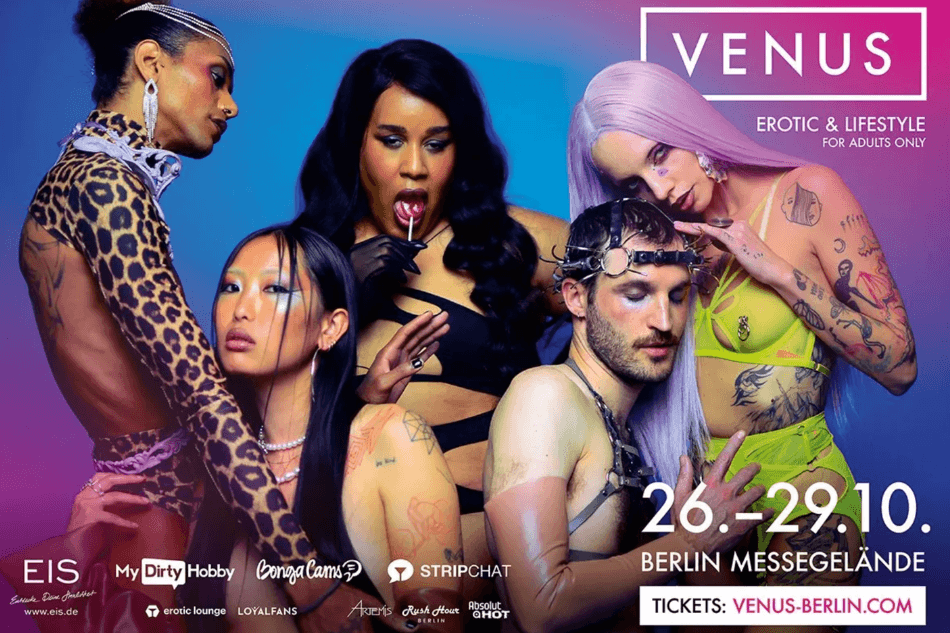
Three years ago, VENUS answered that question with diversity. The 2023 campaign was shot by Chris Philipps of the Berlin collective Pornceptual, a name instantly recognisable to anyone inside the city’s kink and queer underground. That mattered. It signalled that Europe’s biggest erotic fair wanted to be read not only as a marketplace for pornography and pleasure, but as a participant in a cultural conversation, one with real roots in the scene it was borrowing aesthetics from.
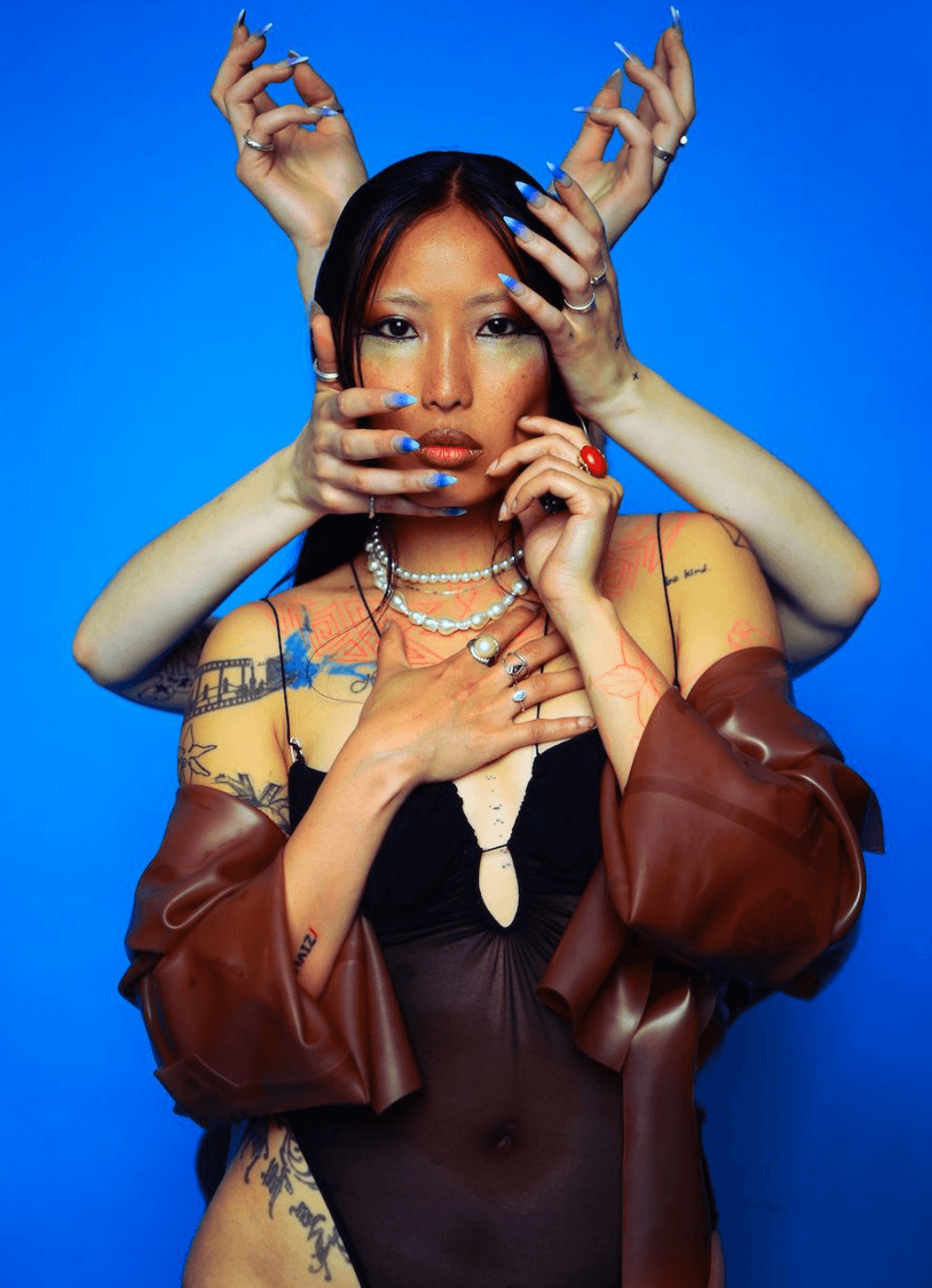
The queer spaces that year were new. So was the framing: an inclusive campaign motif, built to bring polysexual and bi+ visibility into a historically cis heteronormative industry.
The 2026 Ambassadors
This year, the poster tells a different story.
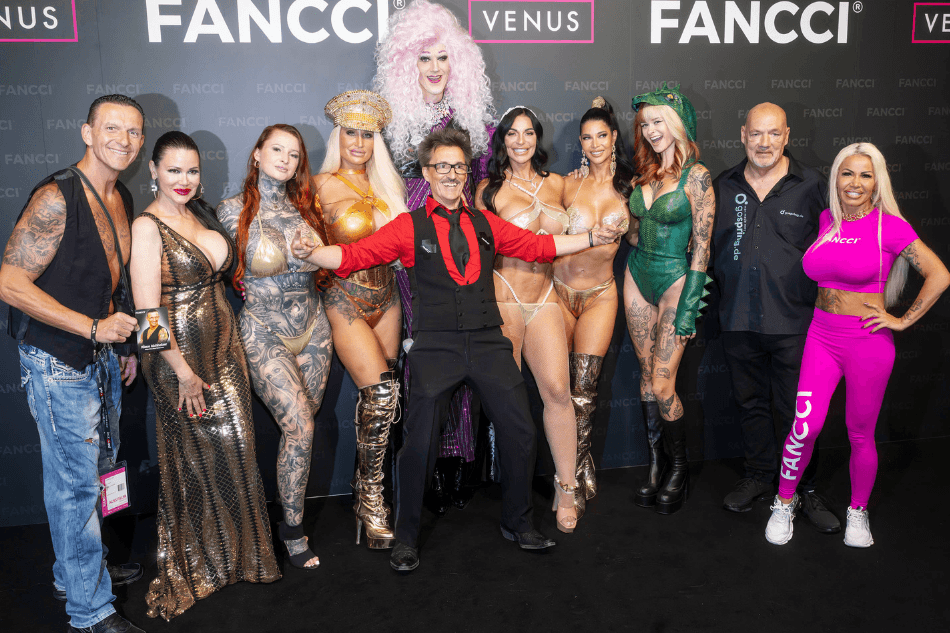
The queer spaces have not disappeared from the fair itself. Workshops around body positivity and sexual health remain part of the programme. But the campaign face has changed. VENUS 2026 is fronted by seven brand ambassadors, and for the first time the organizers are naming the shift outright: this is a generation of women who built their own careers, through social media, platforms, and their own business models, rather than being cast by a studio or discovered by a producer.

Among them: Micaela Schaefer, who has anchored VENUS campaigns for over a decade, alongside newer names like Sallydinosaur and Calea Toxic, both built primarily on OnlyFans and short form video before Berlin ever gave them a stage.
This is not simply a new marketing strategy.
It is a different imagination of freedom.
From Visibility Politics to the VENUS Berlin 2026 Creator Line Up
Two Decades of Recognition Politics
For almost two decades, sexual politics in Europe revolved around recognition. Marginalised communities demanded visibility. Queer people fought to exist in public space without apology. Sex workers demanded rights rather than rescue. Feminists questioned who controlled desire, bodies and representation. Visibility became political because invisibility had always been political.
A New Language of Business
Today another language is becoming dominant. Not identity. Not community. Business.
The cultural hero of the contemporary sex industry is increasingly no longer the activist. It is the independent creator.
The platform has replaced the movement.
OnlyFans, Authenticity and the New Ideal
Owning Your Audience
OnlyFans did not simply create a new income stream. It fundamentally changed the story the industry tells about itself. Suddenly the ideal was no longer being discovered by producers or employed by studios. The ideal became owning your audience, producing your own content, controlling your own income and becoming your own media company.
There is something genuinely emancipatory in that transformation. Sallydinosaur, promoted by VENUS itself as part of a new creator generation, built her following on TikTok and Instagram before turning it into an OnlyFans business, on her own terms, without a studio contract in sight. Many creators have gained financial independence that earlier generations could hardly imagine. They negotiate directly with audiences. Decide what they publish. Reject contracts they do not want.
This deserves recognition.
The Price of Permanent Visibility
But every liberation creates new structures.
Economic independence increasingly depends on permanent visibility. Visibility depends on algorithms. Algorithms reward frequency, engagement, consistency, intimacy, accessibility.
The creator no longer sells only photographs or films. The creator slowly becomes the product. Their body, relationships, personality, daily life, vulnerability… Everything becomes content.
The old pornography industry sold fantasies. The creator economy increasingly sells authenticity.
The Numbers Behind VENUS Berlin 2026’s Creator Story
The Curve Was Always Steep
None of this makes the individual stories false. Some creators have built remarkable careers against enormous prejudice. But the platform economy has always sold the exception as the rule.
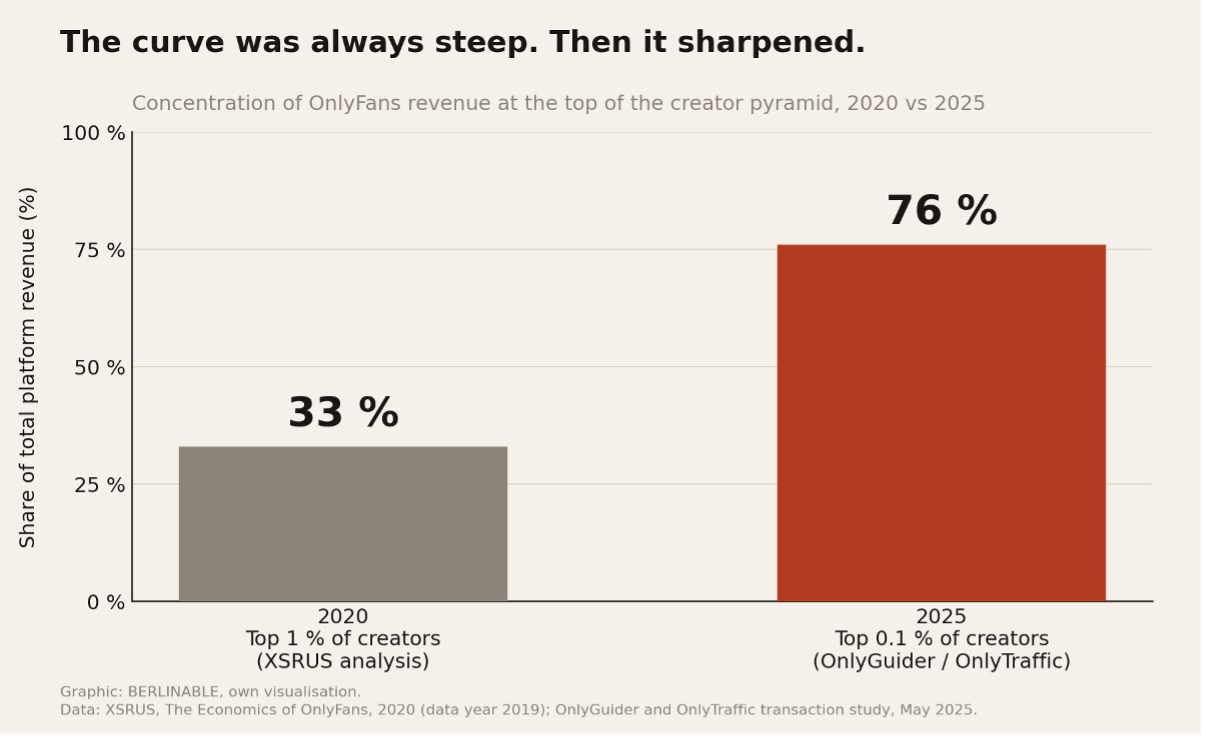
Already in 2020, when the pandemic pushed OnlyFans into public conversation, an independent XSRUS analysis titled The Economics of OnlyFans looked at the platform from the outside and saw a curve, not a democracy. One of the first serious readings of the site, it described a classic power law: the top one percent of creators earning around 33 percent of all revenue, the top ten percent taking home 73 percent, and the median creator making about 180 dollars a month. Not a career. A side income. A number small enough to belong in a household budget, not in a business plan.
Five years later, the curve has not softened. It has sharpened.
The Curve in 2025
A study published in May 2025 by OnlyGuider, with data support from OnlyTraffic, went further than any external analysis before. It examined more than one million subscribers, precisely 1,003,855 of them, and close to 59 million individual transactions. What it found reads less like an update and more like a magnification of what the XSRUS analysis had already seen.
The top 0.1 percent of creators now capture around 76 percent of all revenue, earning on average roughly 146,000 dollars a month. The remaining 99.9 percent divide what is left. Only 4.2 percent of registered subscribers ever spend a cent, and a group of extreme spenders no larger than 0.01 percent of users, so called whales, is responsible on their own for about a fifth of the entire platform’s income.
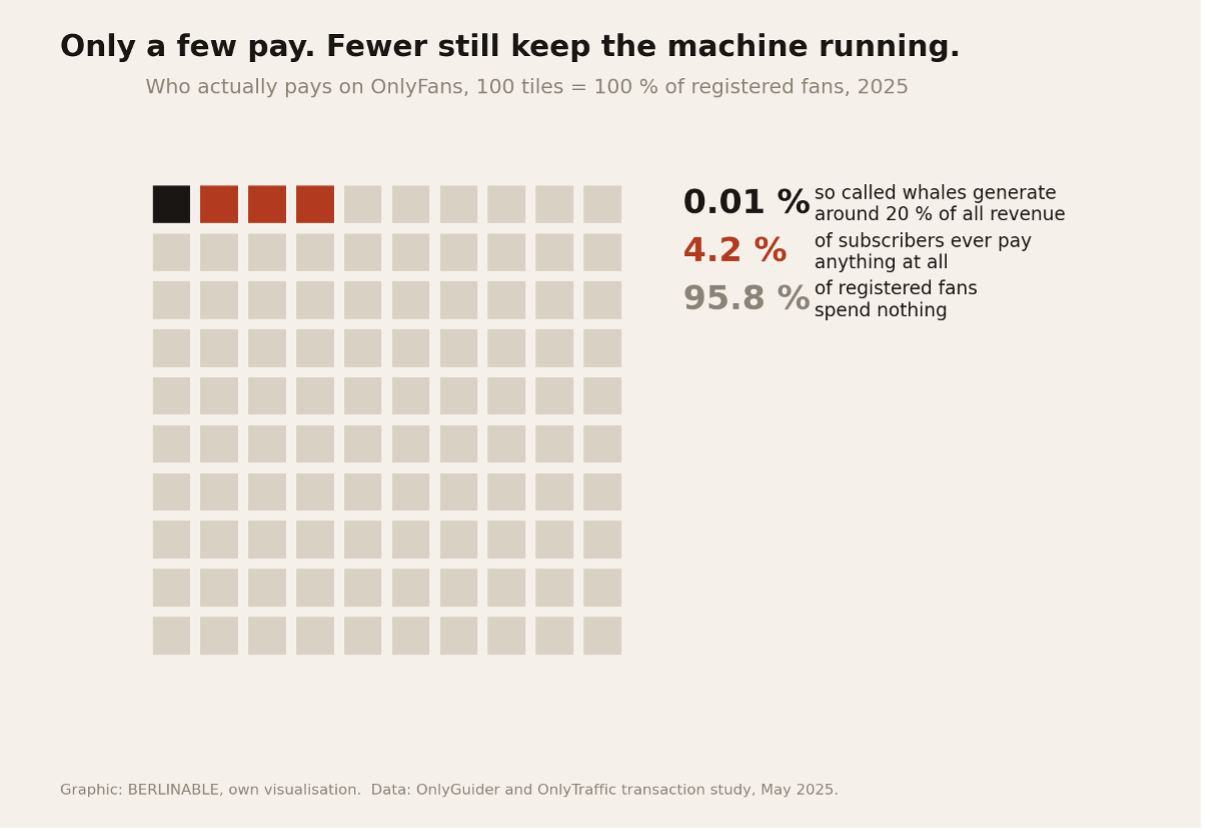
Even the shape of the transaction has changed. Subscriptions, the founding promise of the site, now account for just over four percent of revenue. Direct messages and pay per view content account for close to seventy percent. What used to be an economy of monthly access has become an economy of private conversation, sold by the message.

Between 2020 and 2025, the story did not change direction. It only became more honest. The exception has not become the rule. The rule has become quieter, and the exception has become louder.
From Rights to Competition
This changes the political imagination surrounding sexuality.
The question slowly stops being: who gets to be visible?
It becomes: who manages to stay visible?
Those are not the same question. The first concerns rights. The second concerns competition. One belongs to democracy. The other belongs to the marketplace.
What VENUS Berlin 2026 Really Reveals
The Entrepreneurial Turn of Freedom
Perhaps that is the quiet story hidden behind the posters of VENUS Berlin, three years apart. Not that sexuality has become less diverse. Queer communities have not disappeared. Not even that erotic culture has become more commercial.
The deeper transformation is that freedom itself is increasingly being presented as something entrepreneurial. The citizen becomes the creator. The community becomes the audience. Desire becomes content.
And somewhere between those changes, sexuality slowly stops speaking the language of collective liberation and starts speaking the language of platform capitalism.
How a Billboard Tells History
A poster outside an erotic fair cannot explain all of that.
It doesn’t need to.
Sometimes a city reveals itself in the smallest details.
Sometimes history begins with a billboard.
Sources for facts in this article:
- VENUS Berlin, official campaign communication and ambassador announcements for the 2026 edition
- 2023 VENUS campaign curated by Chris Philipps of Pornceptual with imagery by Andrea Galad
- XSRUS, The Economics of OnlyFans, 2020 (data year 2019)
- OnlyGuider, with data support from OnlyTraffic, transaction study analysing 1,003,855 subscribers and 58,947,698 transactions on OnlyFans, published via ACCESS Newswire, May 28, 2025, covered by Yahoo Finance and The Globe and Mail
- Multiples.vc, The 8B Valuation Economics of OnlyFans, May 2025