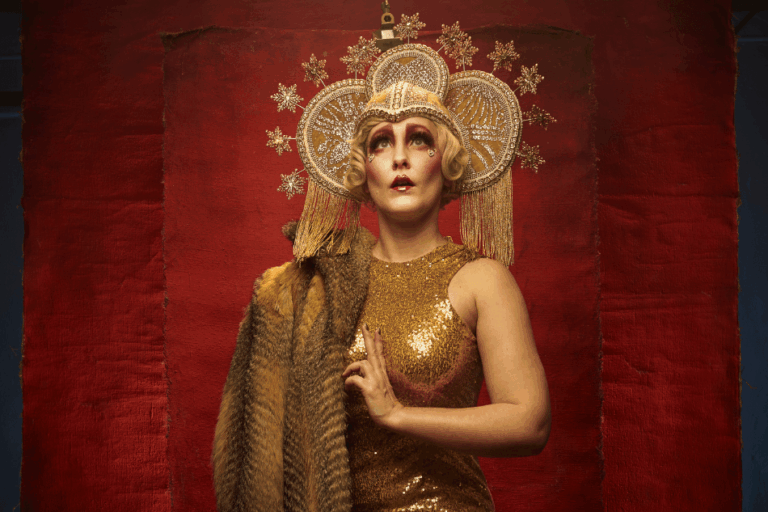
Shibari artist Marie Sauvage says this and looks at you like she already knows. Like she has seen it a hundred times; the moment someone finally stops holding themselves together and just… lets go.
She should know. She has spent eight years tying people up. And watching what happens when they can’t hold on anymore.
Body Reclamation
We are living in a state of permanent low-grade emergency. Always busy, always rushing, always on our phones. Full of traumas we have not processed, wars we watch from a distance, anxieties we manage by buying things, taking things, staying just far enough above the surface to function.
Marie has a name for what she does about this.
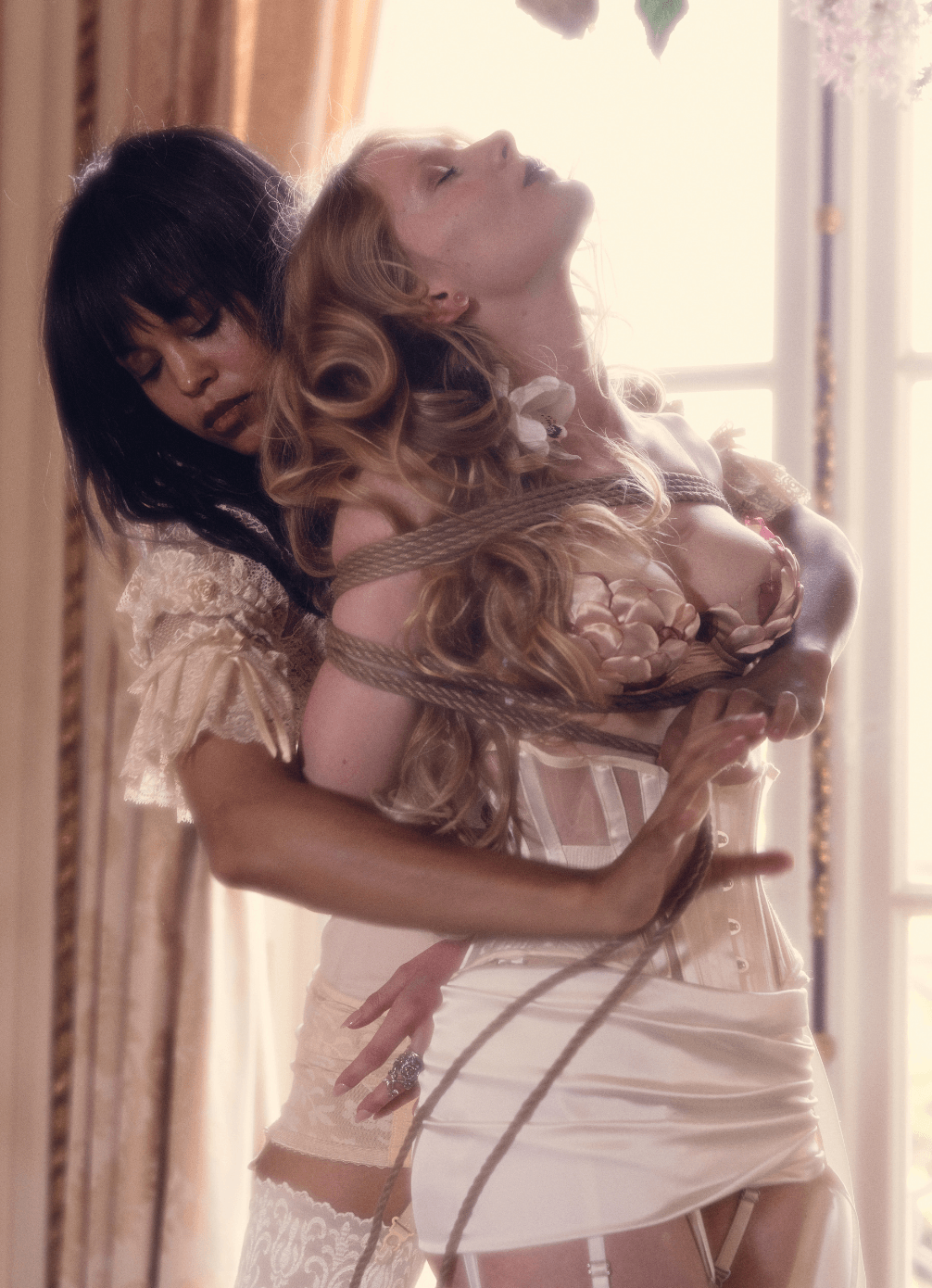
“In the essence – beyond the fetish and the prettiness of Shibari – the real reason why it matters is that it makes people drop into their body and be really present in the moment. More than almost anything.
You can meditate, but it takes time to quiet your mind. When you get tied, you really drop. I can see the before and after of someone when they’re tied. Something really touches them in a visceral way.”
She calls it body reclamation.
The idea is not complicated. The practice is not easy. And it has almost nothing to do with what most people imagine when they hear the word Shibari.
“That’s the basis. Beyond the art, beyond the clothes, beyond the party.”
“The basis is getting in touch with your body again.”
The Wrong Room
Marie Sauvage was born in New York to French parents. She grew up between cultures, between languages, between worlds. Marie studied illustration and graphic design at Parsons (one of the most prestigious design schools in the world). She thinks visually, spatially, narratively. Everything she does, she builds like a universe.
When she was twenty-two, she walked into a porn convention. Not out of desire, out of curiosity. And what she found there was not arousing. It was ugly.
“I thought everything is so cheesy: the presentation, the graphic design, the design of everything.”
“I was like: what if I redesigned something in the sex industry? That was my first thought.”
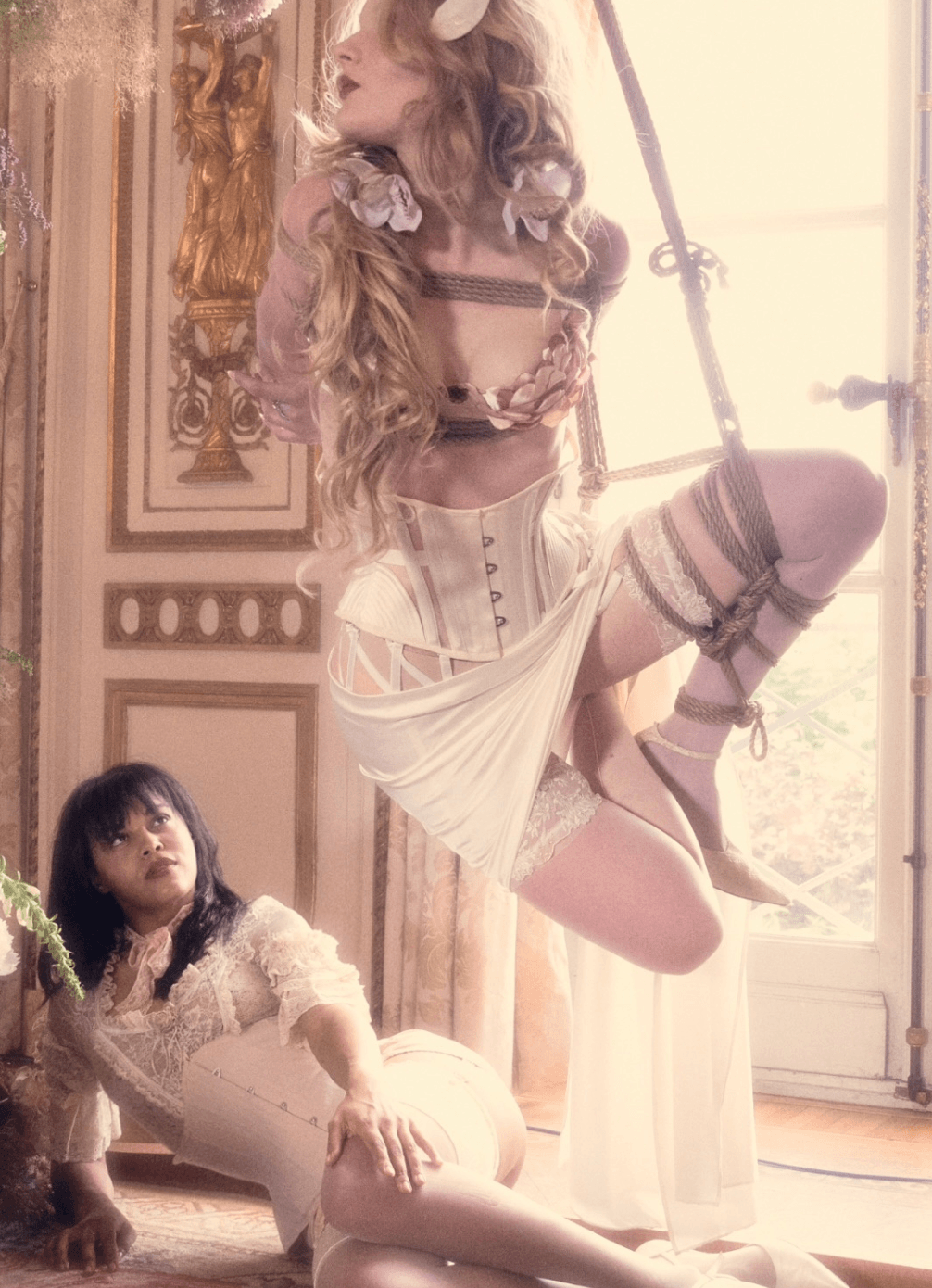
From that moment, she knew she wanted to create something that didn’t yet exist.
“So much of the world was male-centered. It was men tying up women. Everything was catered to men. There was no space where a woman could just express herself without this performative thing in a heteronormative way.”
The spaces that existed were not her world. So she decided to build her own.
“I just wanted to create this universe; this sapphic, beautiful universe where consent was really important and negotiated. Where it wasn’t so much that I’m dominating people. It’s more that I’m creating this space where people can express themselves and be beautiful and be free in their sensuality.”
What Shibari Actually Is
Shibari is a Japanese art of binding people. It derives from hojōjutsu, a martial art used by samurai and police for centuries. Over time, it evolved into kink, then into performance art, then into something harder to name.
Marie resists the pressure to simplify it.
“Shibari is all of the things. And I don’t mean that in a facetious way. There is a big meaning behind that. Some people want to make it into something purely meditative and artistic, to strip it away from the sexual part. And some people still think it’s purely a kink. And I think that there is something wrong in society where you have to separate art and sexuality.”
For Marie, Shibari is artistic, aesthetic, spiritual…and sexual.
All at once. That is not a contradiction. That is the point.
The vocabulary of Shibari is worth knowing. The person who ties is called the rigger (or in Japanese, Bakushi), the rope artist. The person being tied is the model, or sometimes bunny (in Japanese Ukete). Both roles require skill, presence, and trust. Marie moves between them. She ties, and she is tied.
She Learned Shibari From the Best
Marie did not arrive at her practice alone. She trained under some of the most respected Shibari masters in the world — and she speaks about them with a reverence that makes clear how seriously she takes the lineage of this art.
Her teacher Hajime Kinoko, one of the most celebrated Shibari masters internationally, also took her on tour across America as his model. Eight shows. Three tours. Up to seven hundred people watching.

“I had to just leave everything at the door — any sort of insecurity about my body. I was so insecure and was like: oh my god, seven hundred people are going to see me surrender tonight. And then I thought to myself: but maybe they don’t give a shit so much about my body. Maybe they just care that I am giving this gift of myself. Sharing this communal moment of trust.”
That tour changed her. Not just as a practitioner; as a person.
It taught her body acceptance, presence, and what it means to trust someone completely with your physical self.
Her other master teacher, Yagami Ren, works in a style he calls erotic Shibari, fusing his lifelong practice of Aikido with rope. The result is something that sounds impossible until you hear it described.
“He created a form of touch that makes people have orgasms (men and women) just on contact. His touch makes you cum. The rope makes you drop into your body. When you get tied, you become very aware of the edges of your body. And then when he touches you, you are so attuned… more sensitive to what your body’s feeling… that his very sensitive manipulations make you have this orgasm.”
These are not hobbyists. This is a tradition with masters, lineages, and decades of refinement.
Marie carries it — and is building something entirely new from within it.
A Universe You Can Walk Into
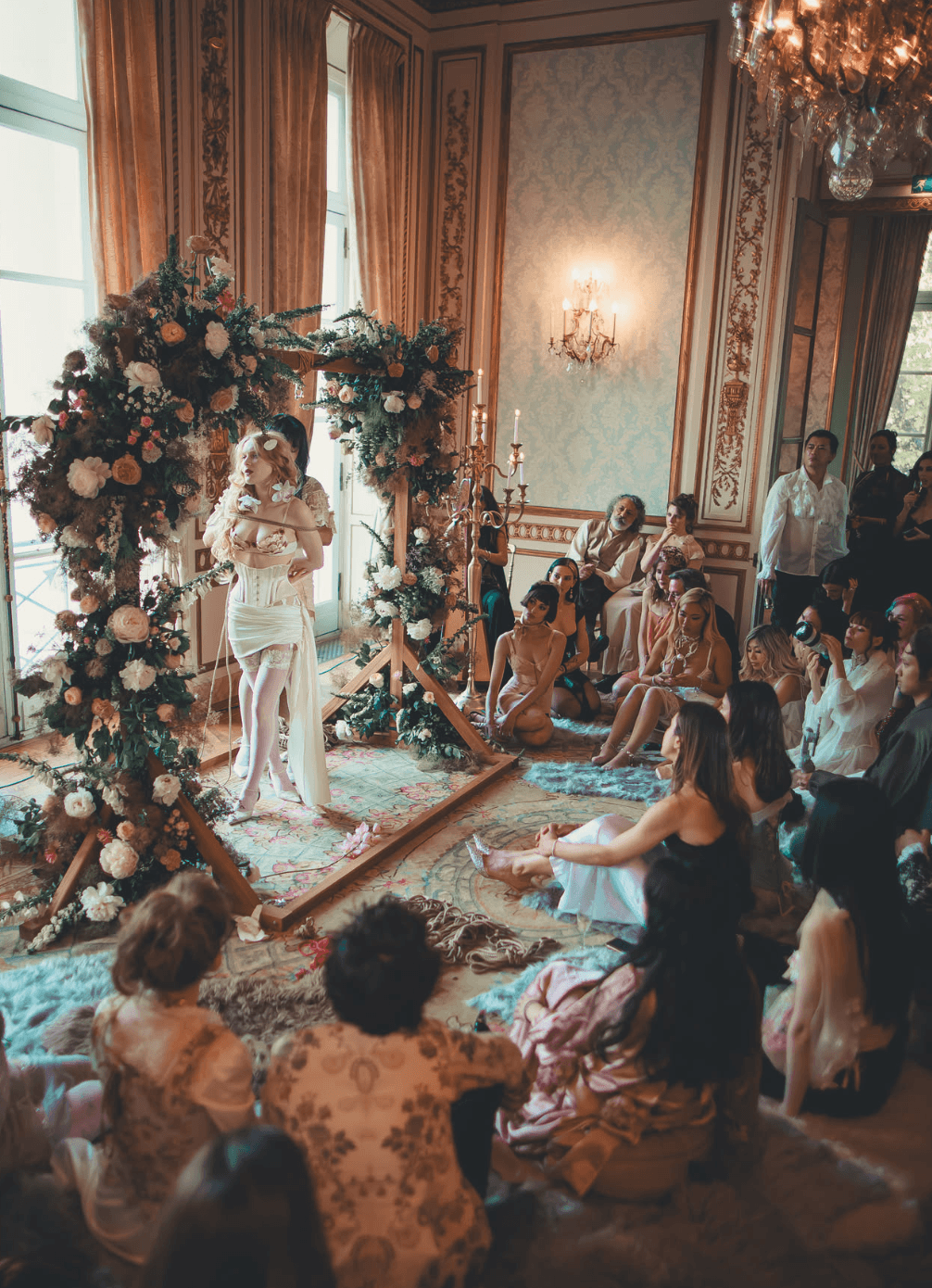
This is where Marie’s Parsons education meets her practice. She does not just create Shibari sessions. She creates total sensory environments. Specific scents, chosen music, soft surfaces, romantic clothing, warm light. The goal is not spectacle — it is transformation.
“Before my page, Shibari was presented in a very straightforward way. I thought: why not create a universe that my community can walk into and immerse. A palace where everyone is dressed in romantic clothing. People can feel transported into another universe and feel themselves become something they feel deep inside.”
She wants people to melt into the space.
“I like to put a special scent in the room and want want people to be able to sit somewhere soft and be close to other people. I want connections to happen between them. Not that they come as a spectator, buy a drink at the bar, and the lights flash in their eyes. I want them immersed in every way. Feeling something really beautiful all over, and feeling transformed by that.”

The concept has a direct historical lineage. Marie read a book one day about the courtesans of 19th century Paris: women like La Paiva, a Russian courtesan who built a legendary palace on the Champs-Élysées, who threw the most lavish salons of the century. Neither wives nor nuns, something altogether more powerful: cultural entrepreneurs at the center of artistic life.
“I took that book and I thought: I want to make a Paris salon too. It’s about these courtesans who would make these spaces, these beautiful rooms where influential people would come and experience art and beautiful people and music, and they would be transformed by the evening.”
Marie has already come close to that dream.
Last year, she held her salon in the castle of Jean du Barry — Marie Antoinette’s stepmother, built by the Sun King himself.
“It was the best thing of my life. I became the ultimate French courtesan in that moment.”
(One year later, Dior bought the castle for forty-five million euros. The universe has a sense of timing.)
Sex Starts in the Brain
One of the most persistent misunderstandings about Shibari is that it is purely physical: rope, body, suspension. People look at it and ask: where is the sex?
Marie’s answer is patient and precise.

“Sex is not genitals. Sex starts in your brain. It depends on what you are attracted to. And if there is a power dynamic at play; people are not aware of how much those things are playing subconsciously in the background at all times.”
The rope, she explains, makes the unconscious conscious.
“When you tie each other, it becomes really clear about who is giving, who’s receiving, how you feel about release, about control, about being seen, about being vulnerable. Things that are kind of automatic in sex (things that are not conscious) become very conscious when you have the ropes on. For some reason.”
That last phrase — for some reason — is delivered with a small smile. She knows exactly why. But she also knows that some things are better experienced than explained.
Consent Is Not a Concept. It Is a Practice.
In a decade of practice, Marie has learned that consent in Shibari requires more than a yes. It requires a structure.
At a Tantra retreat two summers ago, she encountered a framework that she now teaches in her own classes: BDSMA — Boundaries, Desires, Sexual status, Meaning of the interaction, and Aftercare.
“I have people work through a framework where they talk to each other about their boundaries for the container of their session. It allows them not to assume something about their partner, even if they’re married for a long time, even if they think they know each other. I think it’s really important to communicate your intentions and your limits clearly. Even if it’s awkward or uncomfortable. Before you jump into the Shibari.”
She also requires written consent before photographing anyone; making explicit that Shibari is an erotic experience even when nothing explicitly sexual occurs, and establishing clearly what happens to any images taken.
“Consent is super important. I learned a lot of lessons through that. Doing it for some years. So yes, I know.”
Shibari: The Oldest New Art Form
Rope has always meant something. For centuries, it was a weapon — used by samurai and feudal police to restrain, to control, to subdue. Then it became desire and a fetish. Then, somewhere in the translation between East and West, it became something stranger and harder to name: a practice of healing, of presence, of return.
Marie Sauvage stands at the end of that long lineage and the beginning of something else entirely.
She has taken a martial art, an erotic tradition, a meditative practice, a design philosophy, a salon culture, and a politics of the body — and folded them into a single gesture. A knot. What she is building is not therapy, not kink, not performance art, not spiritual practice. It is all of them, unapologetically, at once.
The Germans have a word for this: Gesamtkunstwerk — a total work of art, in which no element can be separated from the whole. Marie did not invent Shibari. But she may be one of the people who finally shows the world what it has always been. Art of the highest form.
Follow Shibari artist Marie Sauvage on Instagram for a glimpse into her aesthetic universe — and find her on Sensuali to discover their full range of services.

Sensuali invites you to explore a curated selection of sensual professionals across BDSM, erotic massage, coaching, arts & more. Discover a wide range of sensual experiences and events, both online and offline.
Join as a member or provider and become part of a growing community of sensual explorers.
Want to see Marie Sauvage live?
Check out her next performance in Berlin on 17. June 2026 here.
This interview was created in cooperation with Sensuali.