Imagine waking up to find your body has been stolen. Not physically — digitally. Your face. Someone else’s naked body. Circulating across platforms you can’t control, in a country that has no law to stop it. This isn’t hypothetical. It’s happening right now, in Germany, in 2026.
When Germany Has No Answer: The Collien Fernandes Case
For years, Collien Fernandes — German actress, TV host, and one of the country’s most recognizable public faces — has been fighting to have pornographic images of herself removed from the internet. Not images she consented to. Images created without her knowledge, using AI and digital manipulation: deepfakes bearing her likeness, spread across platforms and social networks by people she could not identify and laws she could not deploy.
She filed a criminal complaint in Berlin in November 2024. Then, in early 2026, she publicly named the person she holds responsible — alleging a decade of identity theft, fake sexual profiles created in her name, and material distributed to men in her personal and professional circle. The German investigation was temporarily closed because, according to prosecutors, she had not submitted the required documentation. She disputes this. The Spanish case, filed on Mallorca where she was living, is ongoing. For Ulmen, the presumption of innocence applies.
But here is what is not in dispute:
The deepfakes of Fernandes exist. They have existed for years. And Germany has no specific law against creating them.
“Germany is an absolute paradise for perpetrators,” she said in an ARD interview. She had to file her complaint abroad — in Spain — because Spanish law provides stronger protections against this form of digital sexual violence than her own country does.
The International Reality: From Love Island to Every Woman’s Feed
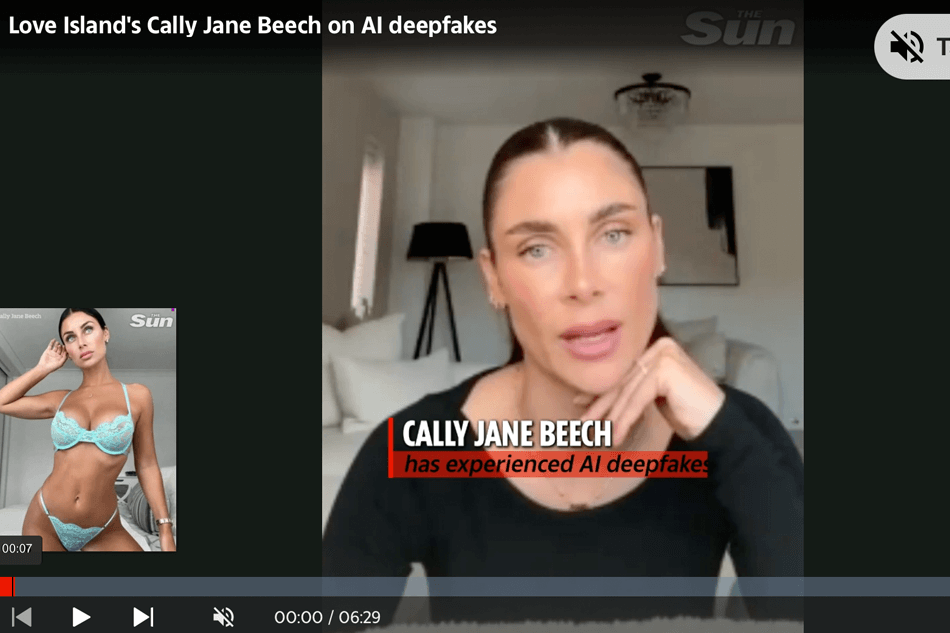
Fernandes is not alone in this — not internationally, and not among women in the public eye. In early 2024, Cally Jane Beech, a British Love Island contestant turned influencer, discovered that AI deepfake technology had taken one of her lingerie photoshoots and “nudified” it: her face, her tattoos, her recognizable body — but someone else’s nakedness layered beneath.
“When I was told there was a nude image on the internet, I knew it couldn’t be me because I’ve never had an explicit image of me taken, ever,” she told The Sun.
What made it worse:
The website hosting the image used her fake nude as clickbait, funneling visitors toward porn sites. She chose to speak out. She is still fighting.
Her story is not an exception. A 2024 survey across ten countries revealed that 2.2% of respondents had been victims of non-consensual deepfake pornography. In early 2024, deepfake images of Taylor Swift spread across X and Instagram, triggering global outrage and urgent demands for digital consent legislation. In nine days, two words typed into Elon Musk’s AI chatbot Grok were enough to generate three million sexualized images of activists, politicians, Holocaust survivors — and children.
Cally Jane’s case felt like a distant headline. Fernandes feels like your neighbor. Like your colleague. Like you.
Why Deepfake Porn Threatens Sexual Progress
For decades, we’ve been unlearning the narrow fantasies sold to us by mainstream porn and filtered social media. We pushed back against Pornhub’s mechanical moans and social media’s polished facades. We demanded more representation, real pleasure and ethical intimacy.
And honestly? It felt like we were winning. Inclusivity wasn’t just a hashtag—it had an impact on runways, magazine covers, and social media feeds. The sex industry began shifting too, with ethical porn producers prioritizing performer consent, showing us what real pleasure looked like, and creators finally finding ways to control their own narratives and profits.
But progress is never one-directional.
While platforms gave performers more control and consent became part of the conversation, sex work still walks a legal tightrope. It’s still criminalized in 170 countries, and about 21% of sex workers reported physical or sexual violence in the past year—most of it unpunished. Nearly 90% say stigma impacts their mental health. These aren’t setbacks—they’re the very reasons to keep pushing.
Sure, we weren’t at the finish line yet—far from it. The beauty industry still pushed pinkwashed products promising transformation, mainstream media still defaulted to narrow representations, and sex work remained stigmatized and legally precarious in most places. But there was momentum, a sense that we were collectively moving toward something more honest, more inclusive, more human.
It felt like progress, messy and imperfect, but undeniably real. But just as things were getting real, deepfake porn and AI crashed the party.
When Progress Meets Regression
Conservative movements gained global traction, and radical right-wing ideologies crept from the darkest corners of the internet into mainstream discourse. These shifts aren’t just political — they reshape how we think about bodies, sex, and power. A cultural regression about who controls bodies, sex, and who gets to decide has been re-emerging.
Enter AI-generated models and deepfakes, who arrived just as sex workers seemed to have finally cracked the code.
Platforms like OnlyFans had given creators unprecedented control over their content and earnings. But AI is stripping them of this. Adult AI models — always available, bodies fully customizable — compete directly with real creators.
What’s even more freaky is that some of these AI models are actually deepfakes: fake images or videos of real people that look incredibly real. This technology doesn’t just compete with humans; it steals their faces and bodies to create non-consensual pornography. We’re not just fighting impossible beauty standards — we’re fighting for our right to exist online without becoming someone else’s sexual property.
Germany’s Dirty Secret: The Law That Doesn’t Exist
Here is the fact that should make you furious:
In Germany, creating deepfake porn is not explicitly illegal.
There is no law in the German criminal code that specifically addresses AI-generated pornography. Victims can attempt to invoke adjacent statutes — the right to one’s own image, §184k StGB on intimate image abuse — but legal experts consider the existing provisions woefully insufficient. The maximum sentence for distribution under current law: one year. Creation itself? Effectively a gray area.
This is why Fernandes filed her complaint in Spain — not Germany. Spanish law provides sharper protections. Germany, the country that prides itself on rule of law, had none that fit.
“We have legal gaps. There is currently no law that specifically addresses pornographic deepfakes.”
— SPD MP Carmen Wegge, March 2026.
HateAid, Germany’s leading organization against digital violence, had already submitted a legislative proposal in January 2026 — before the Fernandes story broke — recommending that both the creation and distribution of sexualized deepfakes be criminalized. The proposal built on the existing §184k, which currently only covers intimate images where the depicted person was “protected from view” — meaning photos taken in a sauna, for instance, aren’t even covered.
The Fernandes case accelerated what advocates had been demanding for years. Federal Justice Minister Stefanie Hubig announced she is fast-tracking a new law, including two entirely new criminal statutes. Her words: “From my perspective, the creation and distribution of sexualized deepfakes should be a criminal offense.”
Thousands of protesters took to the streets in Berlin and Hamburg. The political machinery finally moved. But for the women — and it is overwhelmingly women — who have been living with this for years while lawmakers shrugged: the damage is done.
The deepfakes of Collien Fernandes have been online for years. The laws weren’t.
Someone always pays the price for that gap. It’s never the people who created it.
The Fight Against Non-Consensual Deepfakes
So your sexual energy just hit the floor? You’re not alone. Few things kill the mood faster than realizing that “desire” in the age of AI is being manufactured — and that the people whose images are stolen have no legal recourse in most countries.
But here’s the thing: real arousal doesn’t come from algorithmic perfection.
It comes from watching real people spark off each other, from the messy, magnetic pull of genuine desire. The kind of heat that crackles through the screen and makes your skin hum. That’s what authenticity does—it doesn’t just turn you on, it pulls you in.
And yet, in the age of hyper-scripted, deepfake ‘perfection’, something’s gone numb. The reported prevalence of erectile dysfunction in young men has skyrocketed from just 2%–5% in 1999 to 20%–30% today. The more polished the pixels, the less our bodies seem to respond. It’s not just porn fatigue—it’s disconnection masquerading as desire.
AI might master the mechanics, but it’ll never recreate the magic.
Choosing Authentic Intimacy Over Synthetic Pornography
That magic, that spark you feel when two real people are truly present with each other—that’s where the electricity lives. It’s messy, wild, and often unscripted. It doesn’t come with filters or flawless lighting. It comes with stretch marks, hesitation, and real damn chemistry. The machine can copy the mechanics, but it can’t capture the magic.
Authenticity isn’t just morally superior to its artificial alternatives—it’s more interesting, more surprising, more alive. And a lot more satisfying.
We’re not just fighting for better porn. We’re fighting to feel something again.
We need to push back, and we need to do it together. This means supporting platforms and creators who prioritize real humans over synthetic alternatives. It means demanding transparency about AI-generated content and pushing for legislation that protects people from non-consensual deepfakes.
Most importantly, it means refusing to let technology convince us that synthetic is superior to real. Every time we choose authentic creators over AI alternatives, every time we celebrate real bodies in all their variety, every time we insist that consent and humanity matter more than perfect pixels—we’re casting a vote for a world where people control technology, not the other way around.
How to Combat Deepfake Porn — Starting Now
It starts with small choices that add up:
- Seek out and support real, ethical creators who value consent and craft.
- Educate yourself about deepfake porn and demand legal protections for those impacted. If you’re in Germany: the legislative process around §184k StGB reform is happening now. Your voice matters.
- Support organizations doing the work. HateAid offers free first consultations for victims of digital violence in Germany. Use them. Share them.
- Be critical of what you consume. Ask: Who created this? Who benefits? Is this a real person?
- Talk about it. Normalize conversations about pleasure, intimacy, and what it means to be real in an age of simulation. Collien Fernandes spoke out. She shouldn’t have had to do it alone, and the women before her, who couldn’t afford lawyers or public platforms, didn’t even have that option.
This Isn’t Just About Porn
It’s about culture. Capitalism. Connection. It’s about how easily we let the algorithm tell us what desire should look like. And what happens when we let machines define the most human thing we have: intimacy.
So here’s the ask: Don’t settle for frictionless fantasy. Don’t numb yourself with perfection. Reach for something—and someone—real.
The Real Rebellion Against Artificial Pornography

Every time you choose awkward over optimized, stretch marks over CGI, connection over clicks—you’re voting for something bigger. You’re choosing to feel again.
In a world obsessed with fake, the most radical thing you can do is crave something real.
Choose the glitch. Goosebumps. The surprise.
Choose real.